

I often joke that there is nothing more profitable than a nonprofit hospital. Sadly, in many cases it is not a joke.
A good example is right here in Washington, DC, where we have the nonprofit MedStar Georgetown University Hospital only a few miles from the for-profit George Washington University Hospital. According to Georgetown’s 2025 nonprofit tax return, it booked $158 million in “profit.” By contrast, GW (which is a joint venture between the University and Universal Health Services) booked just $48 million in profit, less than a third as much. Yet Georgetown, the more profitable of the two, pays neither income nor property taxes. GW is required to pay income taxes[i] and, according to DC records, it pays $2.6 million in local property taxes.
This is not an isolated case, and the pattern extends beyond hospitals. A recent empirical study by Elizabeth Plummer, Kahler Doyle, and Ge Bai, “Profitability of Nonprofit and For-Profit Ambulatory Surgery Centers,” found that centers run by nonprofit networks are more profitable than centers run by for-profit firms.
The authors analyzed the financial data for 257 ambulatory surgery centers (ASCs) in Pennsylvania. Although nonprofits ran barely one in five centers, they captured more than half (51.5%) of all the centers’ net income. They also found that nonprofit ASCs were larger, had higher median net patient revenue, and had larger profit margins. Indeed, more than a quarter of nonprofit ASCs had profit margins above 51%.
A broader study comparing nonprofit and for-profit hospitals by Jihwan Moon and Steven M. Shugan in the Journal of Marketing Research dashes the conventional wisdom that for-profit hospitals are inherently more expensive and, thus, more profitable than nonprofits.
They write:
Our empirical analyses reveal that nonprofit hospitals have higher (not lower) average prices…and larger (not smaller) profits than for-profit hospitals. …Of the 90 most profitable hospitals, 64% are nonprofit. In Massachusetts, the six most profitable hospitals are nonprofits...On average, nonprofits have 29% greater profits than for-profits. These findings hold after accounting for investment costs, nonprofit tax benefits, and other factors…Surprisingly, nonprofit hospitals achieve greater profits with higher average prices than for-profit hospitals. [Emphasis added].
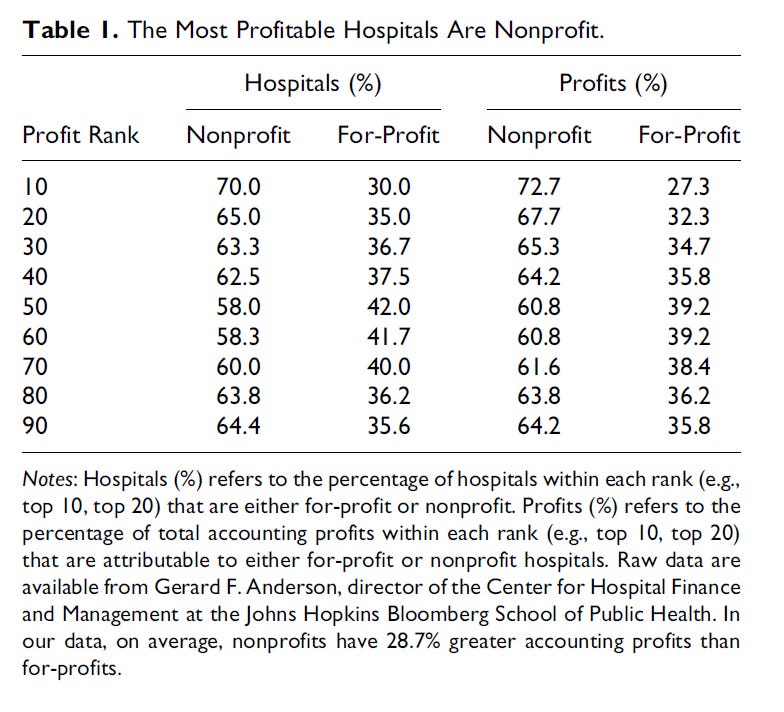
I guess it is easy to be profitable if you don’t pay taxes, right? Not so fast. Moon and Shugan found the gap persists even after accounting for tax benefits. They determined that nonprofit hospitals are more profitable because they provide more premium specialty medical services (PSMS) than for-profit hospitals. These services include neurosurgery, oncology, and neonatal care, services that are more expensive—and profitable—than basic services. And they market those services more aggressively than for-profits.
The late political satirist P. J. O’Rourke once quipped about the Clinton Administration’s attempts to lower health care costs by overhauling the system: “You think health care is expensive now, just wait ‘til it is free.”
What O’Rourke was describing was the moral hazard of government subsidies. When subsidies mask prices, people overuse the resource, and costs run away.
Tax exemption is also a government subsidy, but this one flows to the hospital rather than the patient, and it comes with no strings attached. Lawmakers assume nonprofit hospitals will turn their tax savings into charity care. Not so, as we showed in my latest article on Georgetown. The evidence says many turn them into neurosurgery wings and ad campaigns, competing for the same well-insured patients as their taxpaying rivals—and earning more doing it.
If nonprofit hospitals want to behave like businesses, they should be taxed like businesses. Otherwise, taxpayers and patients remain the losers.
[i] The 2025 financials for Universal Health Services, the parent company of George Washington University Hospital, reported company-wide income before taxes of $1.97 billion and a provision for income taxes of $461 million.